

Texas SB 571 was signed on June 21, 2025. The bill created Chapter 22A of the Texas Education Code, which for the first time treats vendors and contractors the same way it covers school employees. It amended the Texas Family Code’s child abuse reporting requirements. Its companion, HB 4623, took effect September 1, 2025, and created new civil liability for public schools and professional school employees in cases of sexual misconduct involving students or a failure to report suspected abuse.
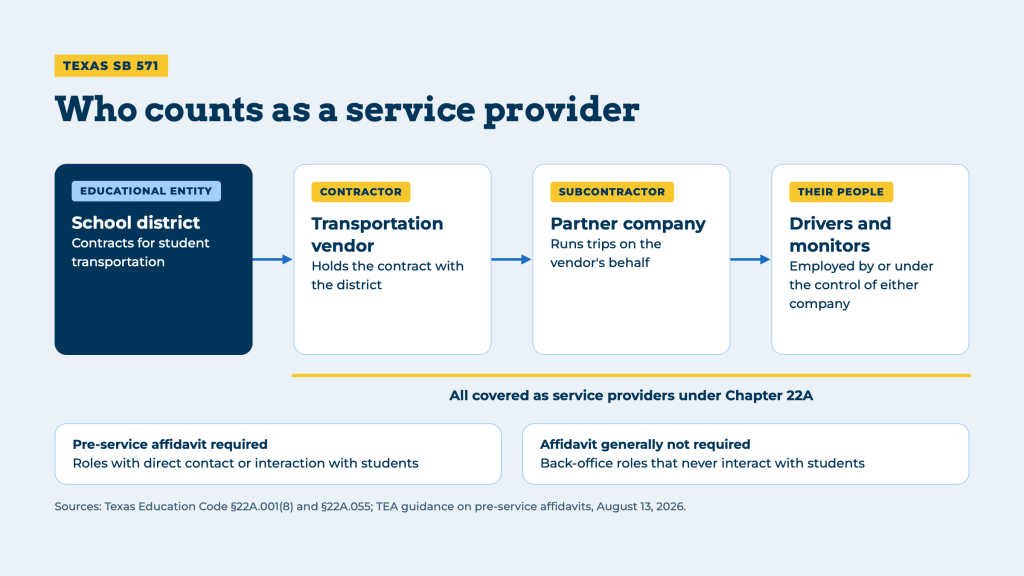
These changes extend beyond district employees. SB 571’s reporting rules apply to service providers (defined broadly as contractors, subcontractors, staffing companies, or anyone working for or under the control of those companies) who work directly with students, which includes transportation vendors. That raises the compliance and liability bar for how districts vet and oversee the partners who bring students to school every day.
This guide is a practical explainer covering what changed, who it affects, and what districts should ask their contracted service providers. It also looks at what the new notification rules mean for caregivers and families.
SB 571 vs. HB 4623: What Each Bill Does
- SB 571 code requires anyone with any notice to report suspected child abuse to DFPS or law enforcement as soon as possible. That duty is personal, which means telling a supervisor, dispatch, or the district doesn’t count as making the report. It applies to every adult, regardless of their employer or contractor of record. Professionals, including teachers and service providers, have a 24-hour duty to report.
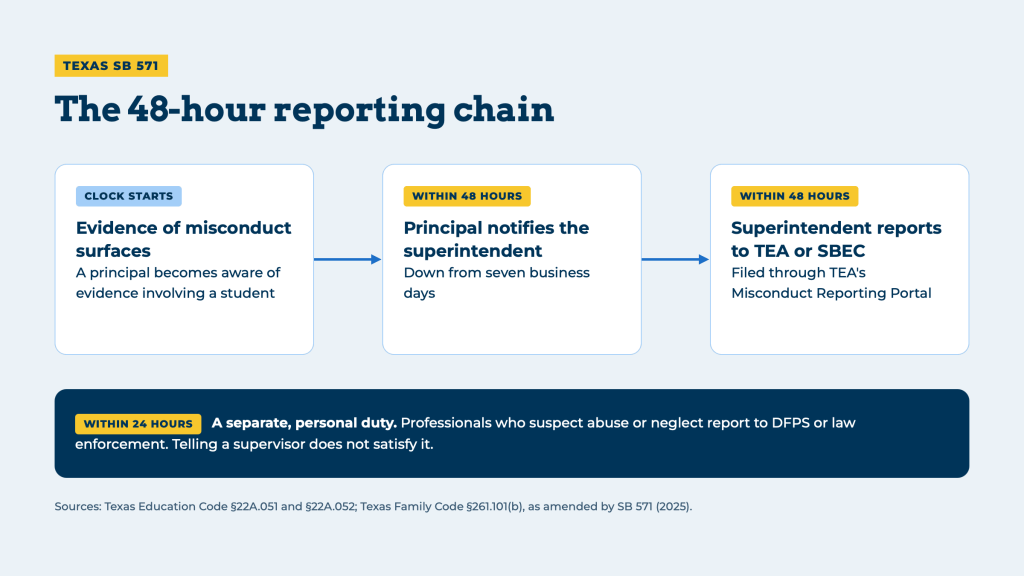
It also shortens the deadline for district administrators. When a principal learns of evidence that an employee or service provider’s worker engaged in misconduct with a student, the principal has 48 hours to notify the superintendent. The superintendent then has 48 hours to report misconduct to the Texas Education Agency (TEA).
- HB 4623 adds Chapter 118 to the Civil Practice and Remedies Code. A public school that is grossly negligent or reckless, or that engages in intentional misconduct, in hiring, supervising, or employing a professional school employee is liable when that employee commits sexual misconduct against an enrolled student or fails to report suspected abuse. A prevailing claimant can recover up to $500,000 in actual damages, plus court costs and attorney’s fees.
SB 571 sets the reporting rules, and HB 4623 sets the financial consequence when hiring, supervision, or reporting falls short. SB 571 names service providers directly, and HB 4623 defines “professional school employee” broadly enough to include roles such as certified school bus drivers and teachers employed by contracting companies. Both laws therefore bear on the vendors a district contracts with as well as its own staff.
New Reporting Requirements for Employee and Service Provider Misconduct
SB 571 tightens the reporting timeline and widens the group of people it covers. Each step in the reporting chain now carries a 48-hour deadline, down from seven business days. The rules apply to State Board for Educator Certification (SBEC)-certified employees, non-certified employees, and service providers.
- A principal must report certain misconduct allegations to the superintendent within 48 hours of becoming aware of the evidence.
- The superintendent must then report those allegations to TEA and SBEC within 48 hours.
- Covered misconduct includes abuse or another unlawful act against a student or minor, a romantic relationship or sexual contact, inappropriate communications, and failure to maintain appropriate boundaries. SBEC defines the last two through rulemaking, so districts should check the current rules.
- A superintendent who fails to file a required report with intent to conceal misconduct commits a state jail felony.
- Professionals who have reasonable cause to believe a child has been abused or neglected must report to the Department of Family and Protective Services or law enforcement within 24 hours.
The table below covers three additional requirement areas.
| Requirement Area | What It Covers | Key Details |
|---|---|---|
| Reporting Portal & Documentation | Where and how required reports get filed | Misconduct reports and responses to TEA subpoenas go through TEA’s Misconduct Reporting Portal. Districts request access to the portal, the Do Not Hire Registry, and fingerprinting services through the TEA Help Desk. |
| Notification for Caregivers and Families | What districts must tell families | The board of trustees or governing body must adopt a policy for notifying a student’s parent or guardian when an employee or service provider is alleged to have engaged in covered misconduct involving that student. The notice must say that the alleged misconduct occurred, whether the person was terminated or resigned before the investigation ended, and whether a report went to TEA or SBEC. Notice is due as soon as practicable. |
| Pre-Employment & Pre-Service Screening | Who must complete the affidavit and fingerprinting, and what they must disclose | Applicants for employment, and service providers whose duties involve direct contact or interaction with students, must consent to the release of their employment records and submit TEA’s affidavit disclosing prior investigations, licensing actions, Do Not Hire Registry status, and any termination, or resignation in lieu of termination, from a school. The requirement follows the person through the contracting chain, so drivers and monitors at a vendor’s partner companies are covered the same as the vendor’s own staff. Fingerprinting is a separate requirement that applies to contracted staff with continuing duties and direct contact with students. Failure to disclose on the affidavit is a Class B misdemeanor. |
For caregivers and families, the notification policy means a district must tell them when someone working with their child is accused of covered misconduct. The notice must also explain what happened with that person’s employment and whether the state was informed.
What SB 571 and HB 4623 Together Mean for School Transportation Vendors
Service providers (as defined above) are named in the statute. SB 571’s reporting requirements apply to employees and service providers, so they reach contracted transportation, tutoring, and extracurricular vendors as well as district staff. The law also bars an educational entity from allowing a person on the Do Not Hire Registry to act as a service provider. Districts should confirm that their transportation vendors maintain screening, reporting, and documentation practices that fit within Chapter 22A.
Vendor screening now carries liability weight alongside its HR weight. Under HB 4623, a district’s exposure turns on whether it was grossly negligent or reckless, or engaged in intentional misconduct, in hiring, supervising, or employing a professional school employee. Districts working with outside transportation service providers can strengthen their position by confirming background check depth, ongoing monitoring practices, and misconduct reporting protocols, and by keeping a record of that oversight. How the statute’s definition applies to a particular vendor’s drivers is a question for legal counsel.
The practical takeaway is that a transportation vendor’s compliance posture and the district’s own compliance posture now belong in the same conversation. Questions worth asking every transportation provider:
- How are drivers screened before their first trip, and how are those screenings monitored afterward?
- How does the provider handle TEA’s pre-service affidavit and Do Not Hire Registry checks for people who will have direct contact with students?
- How quickly will the provider notify the district about an allegation involving someone servicing its students, given the 48-hour clock that starts once a principal becomes aware?
- What compliance documentation can the provider share, and how fast, if the district needs it for an investigation or a report?
- How will the provider support the district when it must notify a student’s caregivers?
How EverDriven Supports Compliance Under SB 571 and HB 4623
As an Alternative Student Transportation provider working with districts across the country, EverDriven has built its safety standards around the documentation and oversight questions these laws put in front of districts. Every driver servicing EverDriven trips must complete pre-service drug testing, multi-layered background checks that include the National Sex Offender Registry, and a motor vehicle record review. Ongoing monitoring follows those checks, and every vehicle must pass an annual safety inspection by a certified third party. More details can be found in our 2026 Safety and Operations Report.
Service Providers use DriverCentral to manage driver assignments and maintain compliance documentation. Where districts opt in, SafeView‘s dual-facing cameras and telematics add another layer of accountability and documentation, with footage encrypted and securely stored.
Technology and screening support the relationship between a student and the driver servicing their trips. The human oversight from Service Provider partners, EverDriven’s local field teams, and district staff keeps that relationship accountable, and it matters most to students with additional needs who rely on a familiar driver to start the day calm.
EverDriven’s practices support a district’s compliance work and do not substitute for the district’s own legal reporting obligations under SB 571 and HB 4623. Districts should confirm compliance specifics with legal counsel.
FAQs
Does SB 571 apply to private schools, or only public school districts?
SB 571 reaches beyond traditional public school districts, charters, ESCs, and shared services arrangements. If you’re contracting with a Texas public school system, assume SB 571 reaches that relationship. Chapter 22A requires the chief administrative officer of a private school to notify SBEC within 48 hours through TEA’s portal, and the shortened 24-hour abuse reporting deadline affects public and private schools alike. HB 4623’s civil liability provisions are narrower, applying to public schools, which the law defines as independent school districts and open-enrollment charter schools.
Can a school district face liability under HB 4623 for a transportation vendor’s conduct, separate from the vendor’s own liability?
Chapter 118 makes a public school liable for its own gross negligence, recklessness, or intentional misconduct in hiring, supervising, or employing a professional school employee, and that defined term includes some contracted roles, such as certified school bus drivers. Whether a given vendor’s drivers fall within it is a question for legal counsel, and the law’s remedies are in addition to any other legal remedies available.
Is there a deadline for districts to adopt the required parent and guardian notification policy?
SB 571’s requirements took effect for the 2025-2026 school year, so districts should treat the policy as a current requirement. The law directs the board of trustees or governing body to adopt it and calls for notice as soon as practicable after the district becomes aware of the alleged misconduct. Districts can confirm adoption status and model language with legal counsel or their policy service provider.
Do SB 571 and HB 4623 apply retroactively to misconduct that occurred before their effective dates?
HB 4623 applies only to causes of action that accrue on or after September 1, 2025, and SB 571’s core reporting provisions apply prospectively, beginning with the 2025-2026 school year. Conduct that predates those dates can still raise questions under other laws, so districts should consult legal counsel about specific situations.

Morgan Judge is an attorney and regulatory strategist with a rare combination of legislative, legal, and private sector expertise. As Senior Director of Compliance, Regulation, and Policy at EverDriven, she leads government relations and regulatory strategy for a company operating at the intersection of technology, education, and a rapidly evolving policy landscape , overseeing multi-state legislative and compliance initiatives, managing contract lobbyists, and working across teams to advance policies that align with EverDriven’s mission and growth.
Morgan’s foundation in law and policy runs deep. She earned her law degree from Loyola University New Orleans School of Law and gained early experience through legal clerkships researching civil law, criminal procedure, and local government policy. She then spent six and a half years as a nonpartisan staff member in a state legislature, working her way from enrolling clerk to senior projects and calendar manager. In those roles she developed deep fluency in legislative process, parliamentary procedure, and the mechanics of how policy actually gets made, experience that now gives her a distinctive edge navigating state-level regulatory environments on EverDriven’s behalf.
Morgan joined EverDriven in 2021 and has grown steadily within the organization, moving from Regulatory Compliance Manager to Director to her current Senior Director role. She is a visible voice in the student transportation policy community, regularly engaging at national industry conferences and advocating for regulatory frameworks that reflect the realities of modern, technology-enabled student transportation.